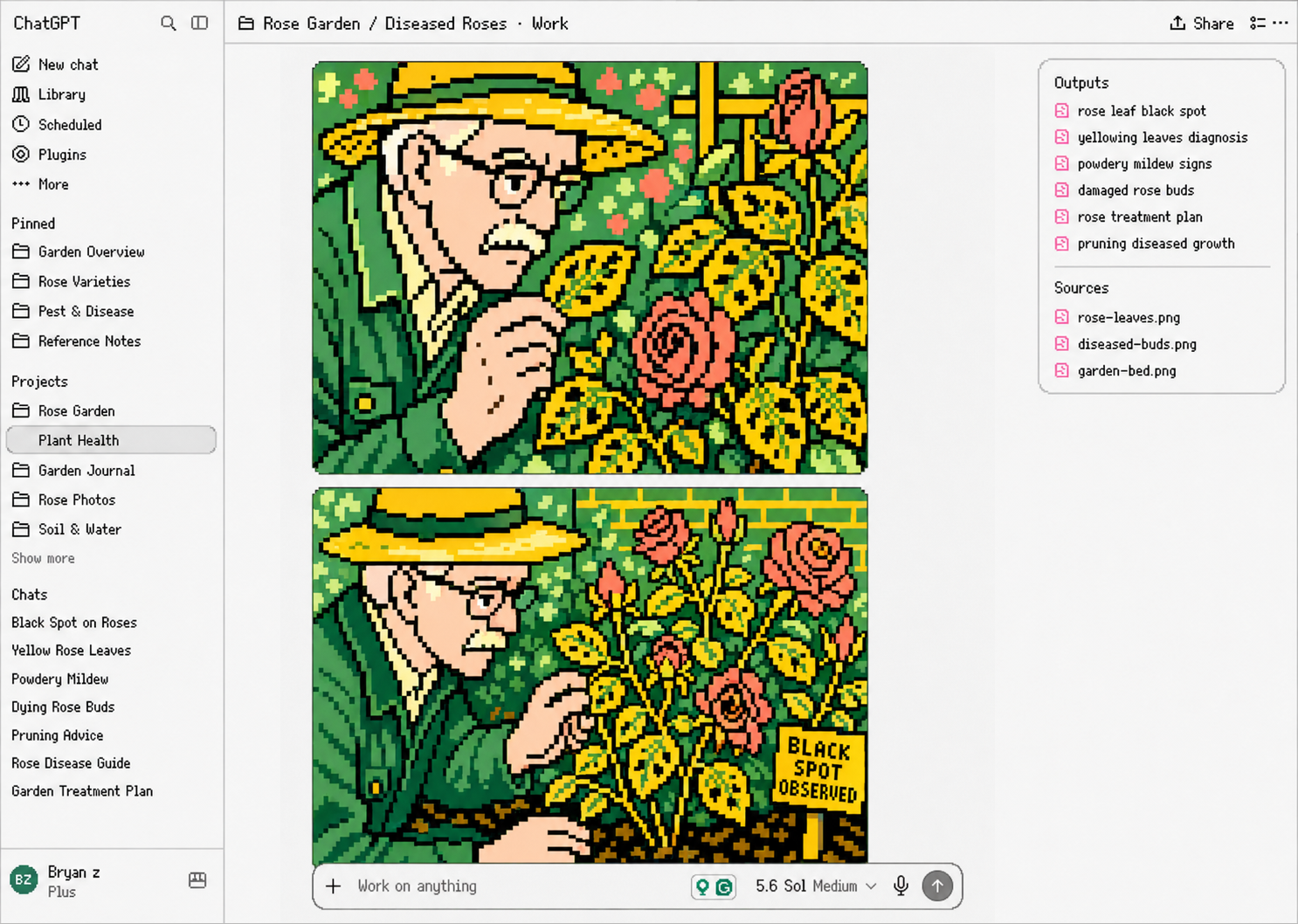
My dad was in town last week. I found him wandering around my rose bushes, and he came inside holding a leaf like it was evidence in a trial. "Something's wrong with your rose bush."
I was making breakfast, so without looking up I said, "Ask Chat and see what she thinks."
He paused. "Chat? What happened to Google?"
That question stopped me. Not because Google got worse, but because my dad never once thought about keywords. He didn't translate the leaf into search terms. He held it up and asked what was wrong. Then he asked if it was serious. Then if it would spread. Then what he should buy. Every answer became the setup for the next question, and by the end he understood the plant, not just the disease.
He wasn't searching. He was having a conversation.
We've been thinking about that all week, because we see the same shift happening in the work. People are learning to arrive with questions instead of keywords. And that changes the job of every page they land on.
The important shift to acknowledge is that AI changes where understanding begins. For years, we assumed customers would arrive on our websites to figure things out. Increasingly, they're figuring things out somewhere else first. By the time they reach your homepage, they're not asking, "What does this company do?" They're asking, "Is this the company that can solve my problem?"
Bryan and I dive into this topic, where he shares some of what’s he’s seeing
The homepage was built to explain
For years, a homepage had one main job: tell people what the product does. Explain the platform. Show where to go next… Lay out the whole story so a visitor could piece it together.
That job made sense when the homepage was where understanding started. It isn't anymore. People show up already educated, sometimes deeply, sometimes wrong, but rarely blank.
They talked to an AI before they got to you. They arrive with context and a question already forming. In most of our sales conversations with customers, they confirm the same thing.
So when a homepage leads with a system diagram of how everything connects, it's answering a question the visitor didn't ask yet. It's telling them how the machine works before they've decided they care.
What the numbers showed us
We've spent a lot of this year helping B2B companies fix exactly this. One of them, a large data company, had a homepage anchored by a big platform graphic. Internally it was sacred. It had been there for years. It showed how all the pieces of the platform fit together, and leadership loved it.
The problem was that almost no participants in our testing could parse it. When we tested comprehension on the original page, most people came away with only a tepid sense of what the company actually did. That's the killer that most people in your business may not actively seeing. You can't persuade someone who doesn't understand you.
You might bamboozle them once, but they leave.
So we stopped trying to explain the platform and started answering the visitor's real question: what is this, and can it help me?
We led with clear feature and use-case messaging, put trust higher on the page, and focused on one call to action instead of scattering attention across the whole screen.
- Comprehension went from tepid to more than 80 percent of people understanding what was going on. Our threshold was 70. We cleared it.
- Engagement climbed, and 45 percent of people funneled into the primary action we wanted, where before their attention had been spread thin across navigation and noise. It was the best-performing test we'd run on that page.
The platform graphic didn’t have to die. It moves to the platform page, which is where someone who already cares about the architecture goes to dig in. It's a great sales vehicle for showing how the parts connect. It's a terrible front door.
It's the menu outside the restaurant
The way I keep describing it: the homepage is the menu outside the restaurant. You don't need to sell the strategy there. You don't need to explain the kitchen.
You need to let people know you have some of the cravings they came for, so they'll walk in.
People don't buy into strategy. They buy into their own problem, and whether you can help with it. Once they're inside, once they trust you, then you can show them how it all fits together. Lead with the architecture and you're asking strangers to care about your internal view of the world before they've decided your world overlaps with theirs.
Get them into the restaurant first.
What AI actually changed
Here's the part that ties back to my dad and the rose bush.

Finding information isn't the hard part anymore. Building understanding is. And once people get used to an AI explaining things to them in plain, patient, conversational answers, static product copy starts to feel flat. Every product is now being compared to something that can explain itself on demand.
That raises the bar. If someone can't understand your homepage in a few seconds, they won't dig through ten tabs to figure it out. They'll go ask ChatGPT instead, and they'll arrive at your next page, or your competitor's, already shaped by that conversation.
So the homepage's old job, explanation, is getting handed off. AI is taking over a lot of the explaining. What's left for the product is everything that comes after understanding: building trust, demonstrating capability, validating claims, and helping people take the next step.
The companies that stand out won't be the ones with the longest list of capabilities. They'll be the ones that answer the question clearly enough that people know exactly what to do next.
My dad figured out his rose bush by asking one question at a time until it made sense. Your visitors are doing the same thing before they ever reach you. The homepage's job isn't to explain everything anymore. It's to meet people where that conversation left off and help them act.