Financial websites are some of the hardest digital experiences to get right. The stakes are higher. The decisions are heavier. And the margin for confusion is thin.
We’ve spent the past few months running rapid UX tests across leading financial brands including Ally, Chime, SoFi, Plaid, and others. We’ve watched thousands of financial professionals and consumers move through pages, react to real interfaces, and reveal what actually drives clarity and trust. What people say is one thing. What their behavior exposes is something else entirely.
Five big ideas for financial websites
- Strong design hides weak meaning
- Winning brands say what matters, then quantify it
- Broad promises create an illusion of understanding
- More benefits do not lead to more persuasion
- Mobile navigation works when it makes user intent explicit
If you lead marketing, digital, or design at a financial company, these patterns will help you avoid the mistakes that slow teams down and cost conversions. And because the work spans dozens of tests, we’ve also created a simple cheatsheet that captures the breadth of what we’ve learned.
Here’s what we are seeing.
1. Strong Design Hides Weak Meaning
Most financial companies assume a polished homepage automatically earns credibility. Clean design. Big hero. Confident tagline.
But the data shows something very different.
Decision-makers in financial services click the most visually dominant element first, even when it doesn’t explain what the product actually does. And because that element absorbs all their attention, any weakness in meaning gets amplified immediately.
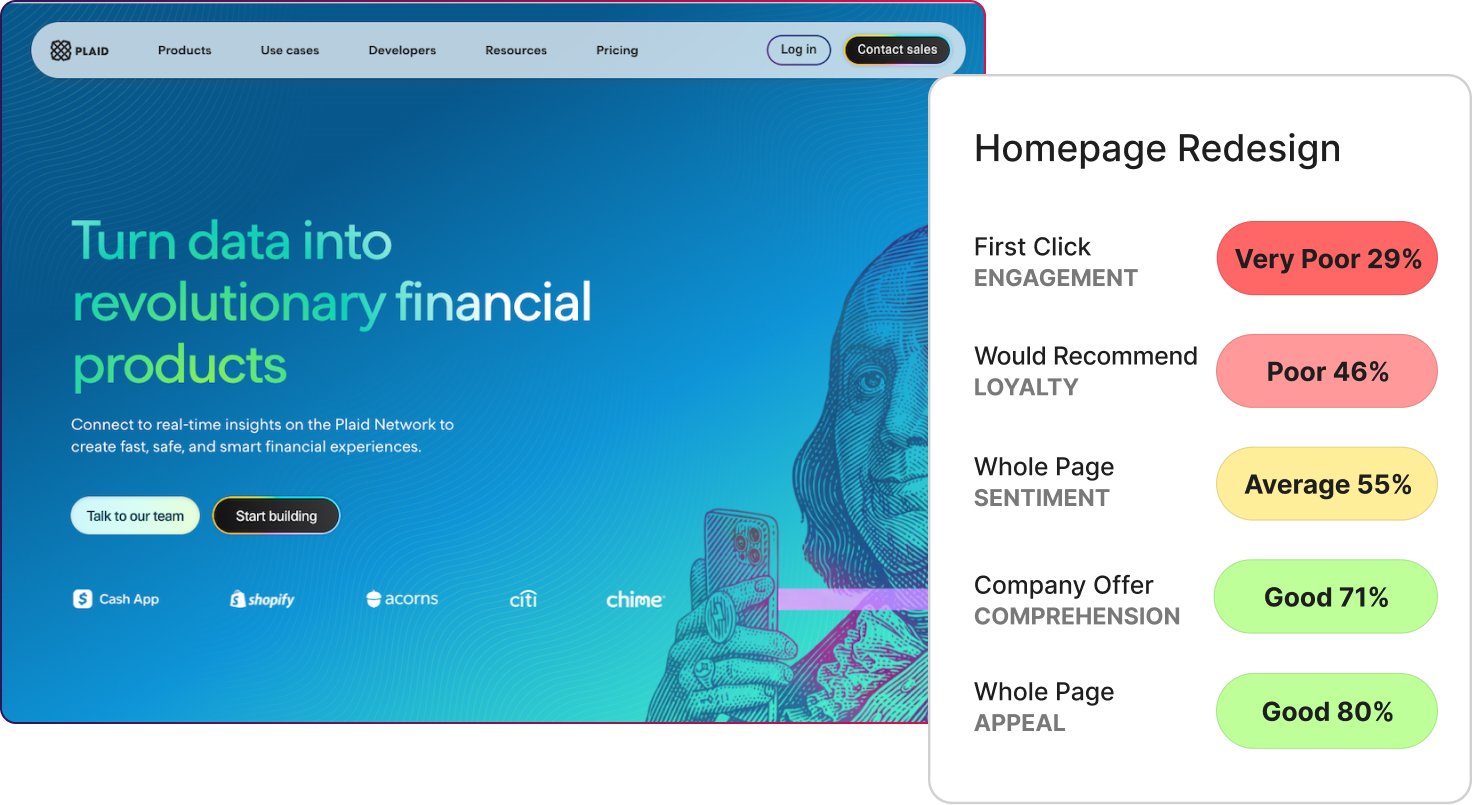
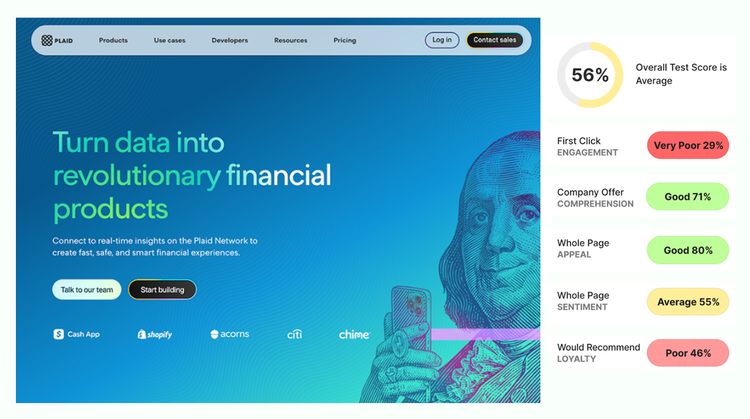
In our homepage test, Plaid saw 29 percent hero engagement and only 46 percent loyalty. Our participant pool of financial services professionals landed confidently but left unconvinced. They thought they understood the message, but follow-up responses showed their grasp was shallow. They couldn’t clearly articulate the product, the value, or the decision path.
This is the clarity trap.
* Design Signal: Strong, appealing design can mask weak meaning, until the moment a buyer tries to make a real financial or operational decision.
And in B2B fintech, the trust decision happens before comprehension.
Executives form an impression long before they parse the details. If your message doesn’t immediately map to a clear business outcome, they don’t have the time or patience to figure it out.
The cost of confusion is simple: they move on.
What to Do Instead
Rewrite your hero to answer one urgent question every financial buyer is trying to solve:
“What decision does this help my team make today?”
Not:
- “Smarter savings starts here”
- “Turn data into revolutionary financial products”
- “The best way to access your pay”
Those lines sound impressive but anchor nothing. High-performing B2B fintech teams lead with:
- A specific outcome (“Approve payments 2x faster.”)
- A specific operational or financial pain (“Eliminate manual verification work.”)
- A specific action the user can take (“Connect accounts instantly with one API.”)
- A proof point (“Trusted by 4 of the top 10 banks.”)
That shift alone changes everything. It takes the homepage from inspirational noise to decision-ready clarity, and that’s what B2B buyers actually need.
2. Winning brands say what matters, then quantify it
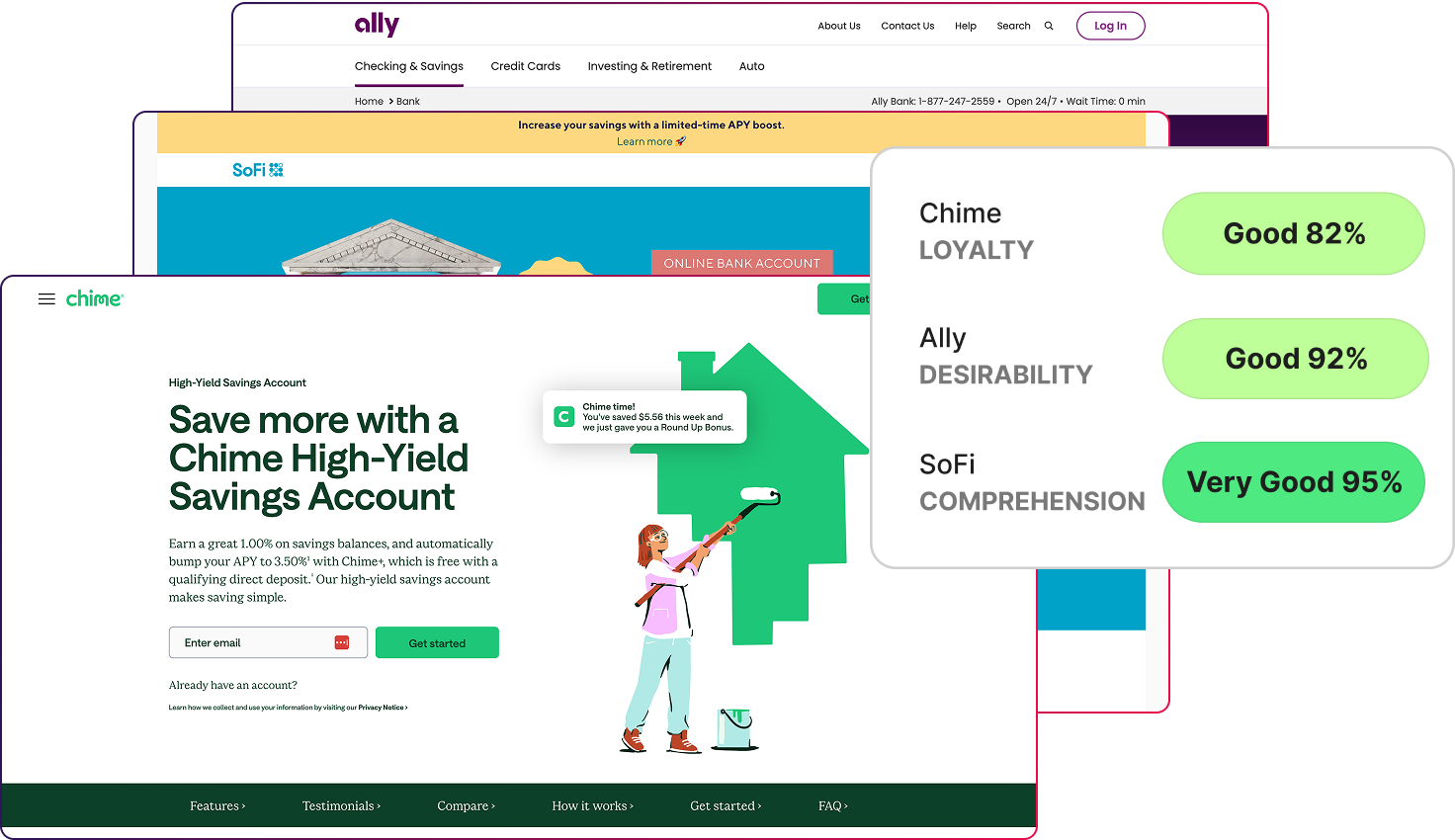
When you look across the competitive analysis we did for Ally, Chime, and SoFi, a clear pattern stands out:
Users reward the competitor who makes financial value explicit, specific, and measurable.
Not the one with the nicest brand.
Not the one with the widest feature set.
Not the one with clever messaging.
The brands with the highest comprehension all do one thing consistently:
They lead with direct language and follow it up with transparent math.
A few examples that outperformed:
- “Easy online banking with up to 3.80 percent APY and no account fees.”
- “Earn a 1.00 percent APY savings bonus automatically.”
- “Open an account today — earn up to $100.”
Users immediately trust offers that put a number behind the value. Because numbers answer a simple emotional question:
“Is this worth it?”
Most financial teams underestimate how much clarity matters in early decision-making. People don’t want inspiration. They want certainty.
* Design Signal: Financial sites are winning not because they have better products, but because they make the value measurable.
If your competitors are vague, you can win quickly by being specific.
You don’t need more emotion.
You don’t need fancier design.
You don’t need new messaging pillars.
You need one thing: a measurable promise.
3. Broad Promises Create an Illusion of Understanding
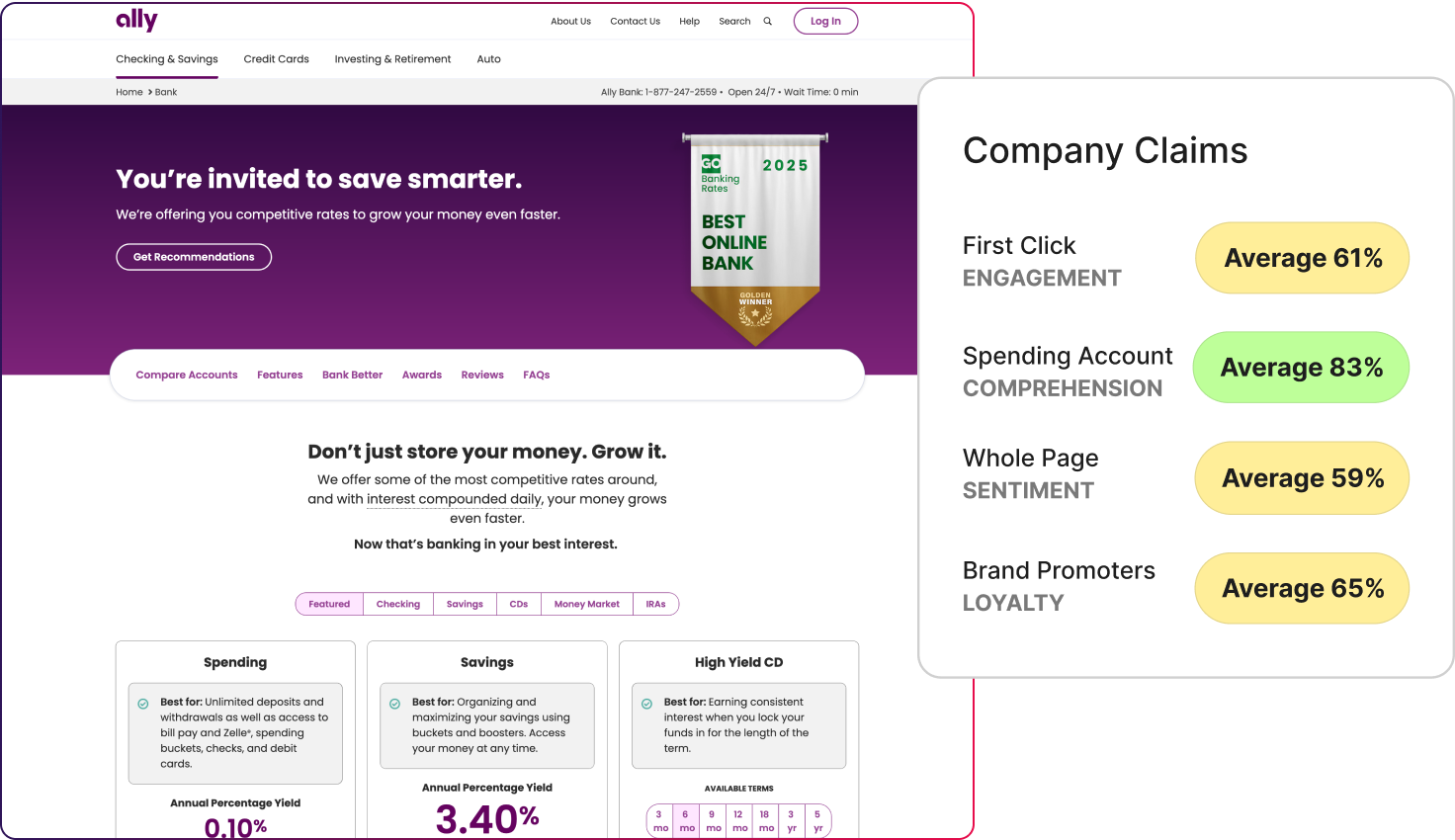
“You’re invited to save smarter.”
It sounds good. It draws attention. It even scores well in comprehension.
But the test results tell a different story: when you zoom out, sentiment and loyalty stay flat. Users say they understand the claim, but their explanations reveal gaps. They think they “get it” because the topic is familiar, not because the value is clear.
This is dangerous in financial marketing.
A vague claim creates confidence without clarity.
And confidence without clarity is how trust erodes.
Users couldn’t answer basic follow-up questions about:
- What “save smarter” actually means
- How the spending account works
- Why it’s better than competitors
- What proof supports the claim
* Design Signal: A claim that feels clear isn’t enough. A claim that is understood in the same way by every visitor is what builds trust and conversion.
What to do instead
Shift from:
Vague financial promise → Specific, outcome-based claim with proof.
For example:
Instead of: “You’re invited to save smarter.”
Use: “Earn up to 4.25 percent APY with no monthly fees.”
or:
“Grow your savings 4x faster than the national average.”
This is the smallest shift that delivers the largest lift.
People trust specificity.
People trust numbers.
People trust visible value.
If your claim can be interpreted ten different ways, your conversions will collapse.
4. More Benefits Do Not Lead to More Persuasion
One of the biggest misconceptions in financial landing pages is this:
“If we list all our benefits, people will find something they like.”
Our Chime test proves the opposite. The landing page listed early pay, overdraft relief, credit building, no fees. Strong benefits. High comprehension. High engagement.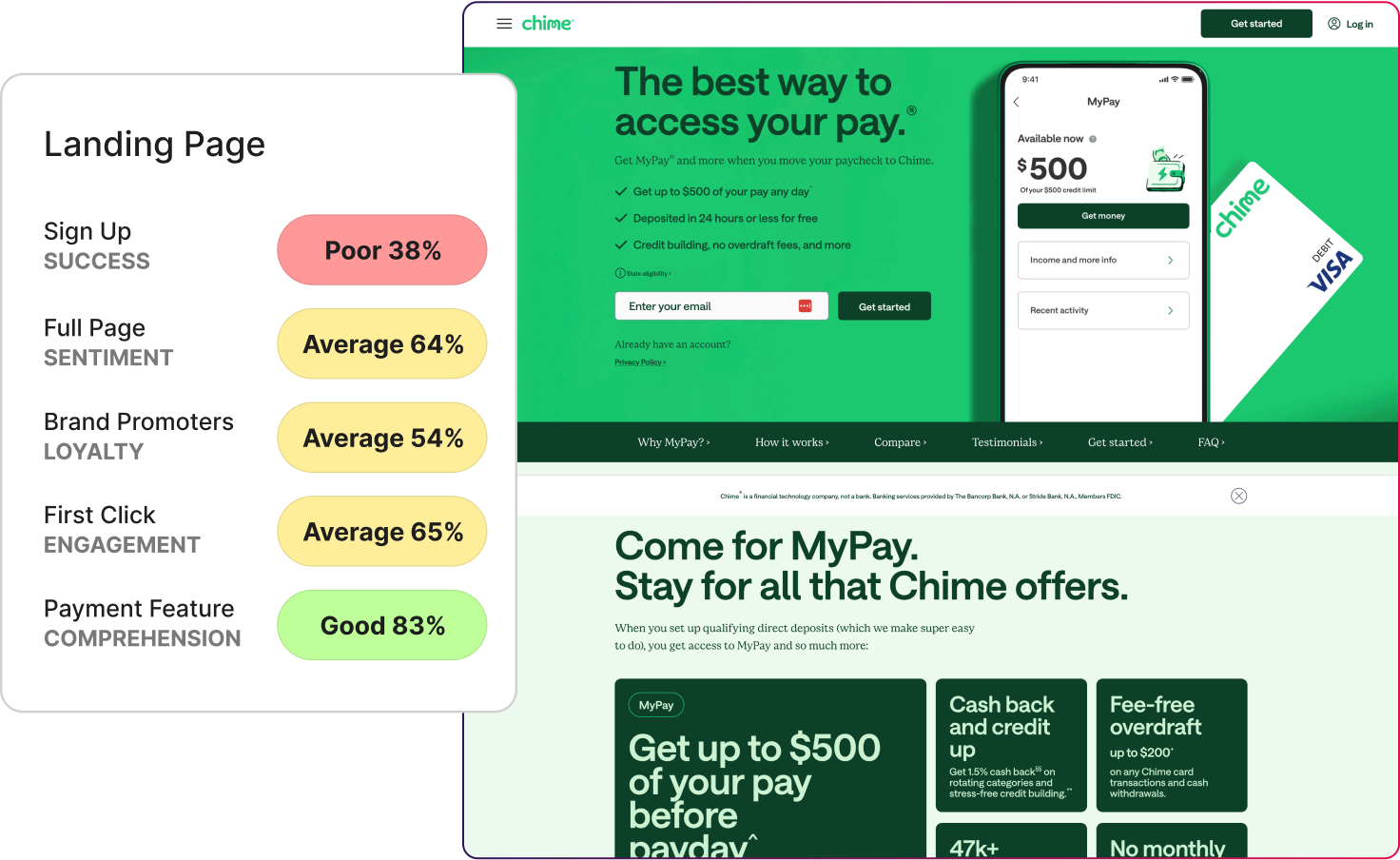
But success was only 38 percent, and loyalty hovered around 54 percent.
Why?
Because people don’t look for the strongest benefit. They look for the benefit that reduces their personal financial uncertainty the fastest.
Not what you want them to value.
Not what differentiates you.
Not what sounds impressive internally.
Users pick what feels urgent to them, and ignore the rest.
* Design Signal: Users understand the claims but don’t yet believe one of them solves a meaningful personal financial problem.
The competitive advantage
Anchor the landing page around one benefit that answers one emotional truth:
“Help me feel more financially secure.”
Then support it with proof:
- Earlier access to money
- Lower fees
- Credit improvement
- Simple savings growth
One controlling message.
One clear benefit.
One next step.
Everything else is secondary.
5. Mobile navigation works when it makes user intent explicit
This is one of the clearest patterns we’ve seen across all our financial UX tests.
On mobile, users don’t scan the page like a website. They don’t explore. They don’t read categories. They enter with one financial intention, and they look for the fastest path to completing that action.
In our Chime navigation test, usability was high (77 percent) and effort was low (90 percent).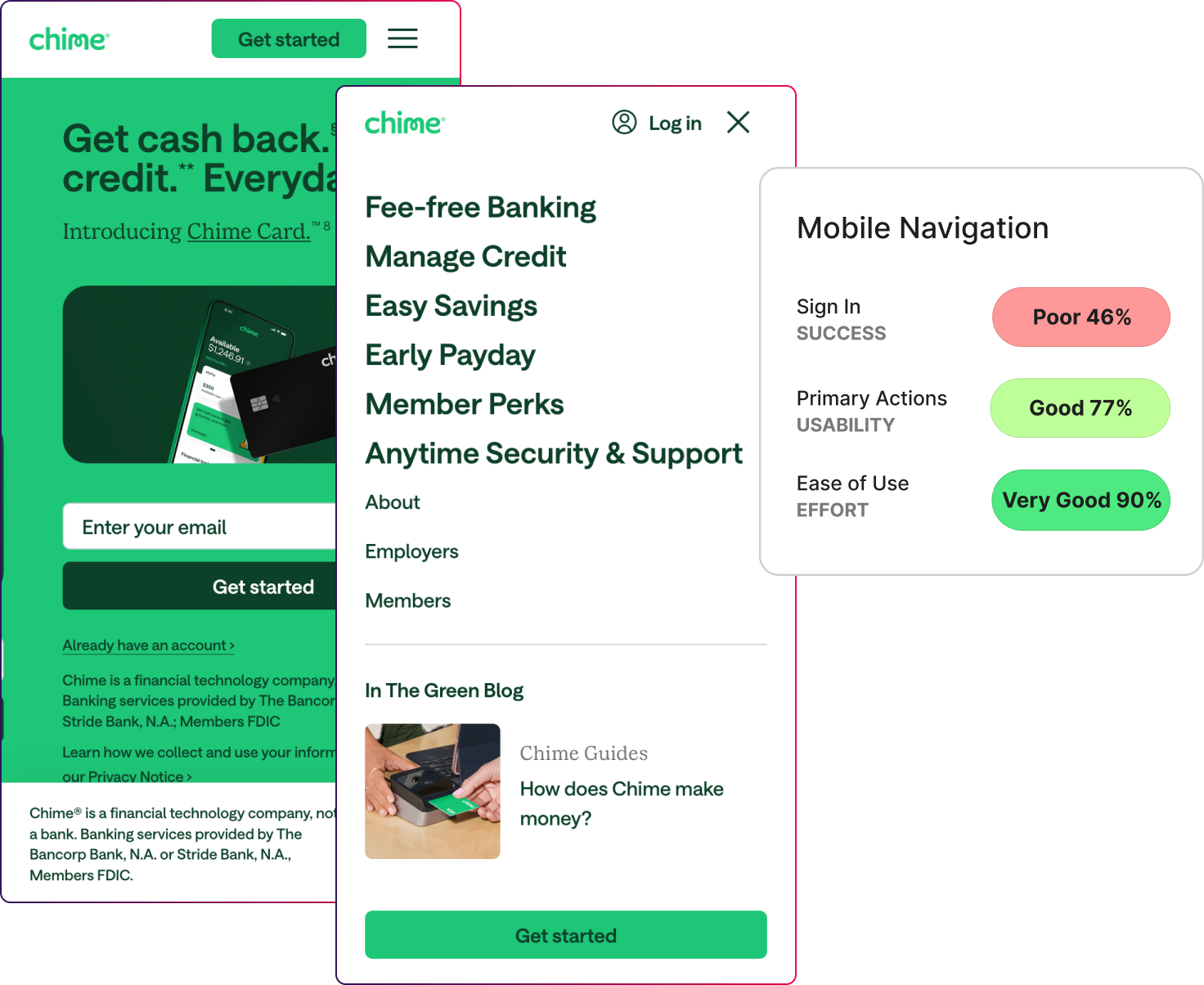 But success was only 46 percent.
Why?
Because users weren’t confused by the menu.
They were blocked by one missing expectation: they couldn’t immediately find where to log in.
* Design Signal: Financial users don’t explore mobile pages. They go straight to the first available action that matches the intention in their head.
What to do instead
Stop organizing mobile menus like desktop IA.
Start organizing around financial intent:
- Make your money last longer
- Get money faster
- Improve your credit
- Open an account
- Stay safe and supported
This reframes navigation from a static list into a set of missions people understand instantly.
This is how you turn usability into success.
The Bottom Line: Financial Teams Don’t Have a Design Problem, They Have a Meaning Problem
Across all our tests, one theme repeats:
People move toward clarity, certainty, and financial relief, not cleverness or aesthetics.
Your competitive advantage doesn’t come from being more creative.
It comes from being more understandable.
Every one of these shifts is simple:
- Explain the decision your product helps someone make.
- Make the financial value measurable.
- Turn vague claims into specific outcomes.
- Anchor landing pages around one benefit.
- Map mobile navigation to financial intentions.
These aren’t design tricks, they are meant to provide clarity for long-term growth.
If you get this right, you’ll move faster than your competitors, not because you redesigned your site, but because you finally aligned your message with what users actually need from you.
Five High-Value Ways We Help Financial Teams Improve Their Websites
If you need support cutting through the complexity of your financial website, we’re here to help. We work with an audience of over one million participants and use insights from 50,000 hours of testing and five million responses to surface the clarity your users need to move forward with confidence.
-
Make your design work credible and reusable across the organization
We turn website signals into simple proof stories that build executive trust and guide marketing and product decisions.
-
Give you the fastest path to real user input without slowing the team
We test with real financial professionals in days so your site keeps pace with market expectations.
-
Turn vague website messages into clear business outcomes
We translate complex financial offerings into simple value that shows how your product reduces risk or improves operations.
-
Bring discipline to your metrics so teams stop arguing
We help you choose the right UX and business signals for financial journeys so everyone aligns on success.
-
Reveal the real problems worth solving fast
We pinpoint where financial buyers get stuck and highlight the highest impact fixes for adoption and evaluation.
Powered by Froala Editor